by Steve Sorbo | Oct 19, 2026 | TCN Content
Apple is reinvesting in the home in a big way. At its Welcome Home product launch on October 13, 2026, the company introduced the long-rumored HomeView—a touchscreen smart speaker for the whole family—alongside an updated HomePod mini and a next-generation Apple TV. Apple is also partnering with LG and Schneider Electric on a line of home automation products.
Here are the ship dates for the new products:
- HomePod mini 2: Friday, October 30, 2026
- HomeView and Apple TV 4K: Friday, November 13, 2026
- Home Collection: Begins shipping in December
Introducing HomeView
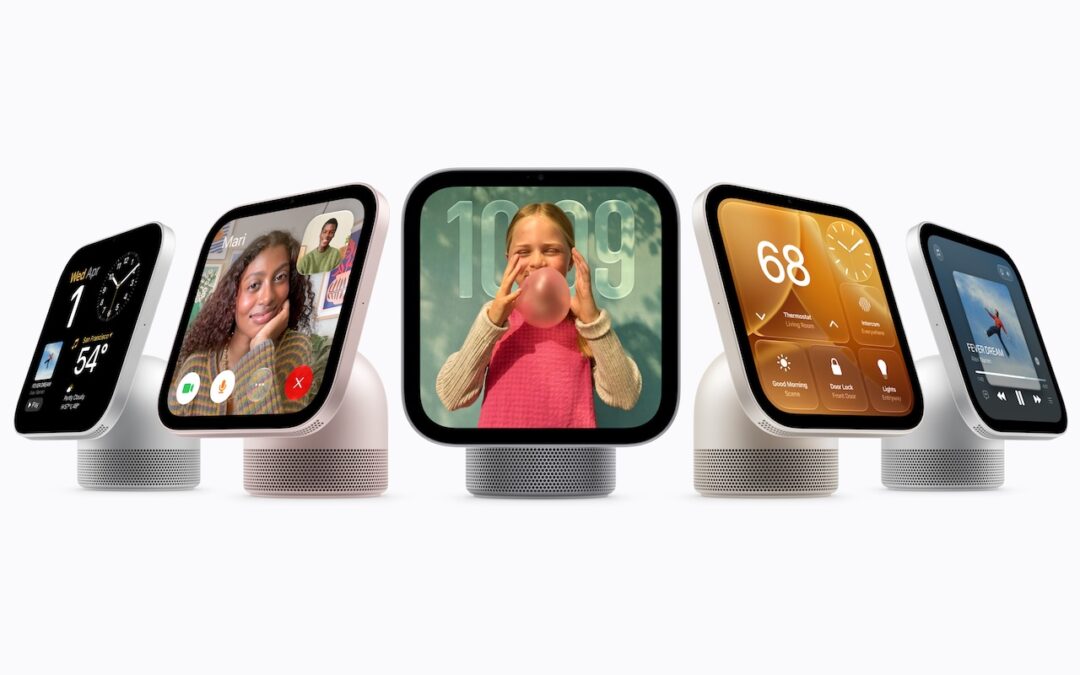
The headline product is the Apple HomeView, a home hub that plays music, controls home automation devices, and makes FaceTime calls. It’s a curious mix of an iPad mini and a HomePod, with a 7-inch display on a domed speaker base. It’s Apple’s answer to Amazon’s Echo Show and Google’s Nest Hub.

The most interesting thing about the HomeView is that it recognizes up to six people by face, and each gets a personalized Home Screen. Apple customers have wanted multiple user accounts on the iPad for years, and this will only increase that demand.

The HomeView has no App Store. It comes with 15 built-in apps, including:
- Calendar
- FaceTime
- Find My
- Messages
- Reminders
Third-party apps are limited to CarPlay-enabled audio and video apps, such as Spotify, which run from a paired iPhone. Like the Apple Watch, the HomeView also supports multiple “faces,” each with different sets of widgets, shortcuts, and stylings.
The HomeView leans heavily on Apple’s new Siri AI, which isn’t available in the European Union, so Apple isn’t selling it there. At launch, the HomeView will be available in the United States, United Kingdom, Canada, Australia, New Zealand, India, Singapore, and South Africa.
The HomeView costs $299 in either of two versions: tabletop and wall-mounted. The wall-mounted version lacks the built-in subwoofer and requires a separate Schneider Home mount: $59.95 for USB-C or $79.95 for AC wired, both available now, or $129.95 for Power over Ethernet (PoE), which arrives in early 2027.

The HomeView makes the most sense for families heavily invested in Apple Home who want a shared control panel for their home automation devices.
It could also work in a small office as a conference-room FaceTime station or a front-desk control panel, but Apple isn’t positioning it for business use yet.
Buy, Skip, or Wait? Wait. Almost everyone can afford to hold off on this one—it’s a product sure to mature and gain more functionality over time.
Fourth-generation Apple TV 4K
At $299, the new Apple TV 4K costs more than nearly any other streaming box on the market, and, puzzlingly, it still doesn’t support 120 Hz video.
Apple TV prices have been climbing steadily, and Apple has blamed soaring demand for memory and storage chips from AI data centers. In June, Apple raised Apple TV prices from $129 to $199 for the 64 GB model and from $149 to $249 for the 128 GB model. Apple has now consolidated to a single 128 GB model, simplifying the lineup.
Beyond the expected speed boost from the A19 chip, the most interesting addition is a set of three far-field microphones for hands-free Siri. It can also drive up to four HomePods for surround sound, either the second-generation HomePod or the new HomePod mini 2. You can mix and match speakers as long as each pair matches—for example, two full-size HomePods in front and two HomePod mini 2 units in the rear. Original HomePod minis and first-generation HomePods aren’t supported.
Since nearly every smart TV and streaming stick now supports the Apple TV app and AirPlay, the Apple TV 4K is increasingly a device for people who want the best tvOS experience, tight Apple Home integration, or an Apple Home hub. If you already own a second-generation or later Apple TV 4K, there’s little reason to upgrade—Apple says Siri AI is coming to your existing box, starting in beta with tvOS 27.2.
Here’s another welcome upgrade for existing Apple TV owners: a new, improved Siri Remote with built-in Find My. It’s included with the new Apple TV but is available as a separate $59 purchase for owners of existing Apple TV HD and 4K models. Precision Finding requires an iPhone Duo, iPhone Air, or iPhone 17 or later (not the 17e). With any other iPhone, you’ll have to make the remote play a sound to find it.
Buy, Skip, or Wait? Skip. The price is hard to justify unless you’re a die-hard Apple TV fan, and the best upgrades are coming to older models.
HomePod mini 2
The HomePod mini 2 offers modest upgrades over the original at a higher price of $149. It will support Siri AI in a future update, while the original will not. It ships in blue, green, midnight, pink, and white.

Beyond serving as surround speakers for the new Apple TV 4K, the HomePod mini 2 can be a Mac’s default speaker, alone or in a stereo pair (the Mac needs Wi-Fi 6E or later).

Another neat feature: the top surface pulses in rhythm with the music, a feature Apple calls Sound Glow.
Buy, Skip, or Wait? Buy, if you’re in the market for a smart speaker, but don’t rush to replace your existing HomePod minis unless Siri AI, Apple TV surround sound, or Mac speaker support matters to you.
Apple Home Collection
Apple has long left smart home hardware to other companies, first through its Works with Apple Home certification, which offered a small assortment of accessories at relatively high prices. Then it embraced the cross-platform Matter standard, which greatly expanded compatible accessories at lower prices, but at the cost of ambiguous accessory reliability and quality.

Apple is now swinging back in the other direction with the new Apple Home Collection. It’s a lineup of cameras, a lock, and thermostats built with LG Electronics and Schneider Electric and sold through Apple’s online and retail stores:
- LG Video Doorbell (Wired): Dual cameras (2.5K facing out, full HD facing down to catch packages), a built-in spotlight, and a chime that plays through a HomeView, HomePod, or HomePod mini. $249.95.
- LG Indoor Cam: Tilts automatically and turns away from the room when someone in the household comes home, so it isn’t recording you while you’re there. $199.95.
- LG Outdoor Cam and Floodlight Cam: Low-light color night vision. The Floodlight Cam adds dual floodlights that turn on when motion is detected. $299.95 and $399.95.
- LG Smart Deadbolt Lock: Unlocks automatically as you approach with your iPhone or Apple Watch, which use Apple’s Ultra Wideband chip to tell when you’re near. It also offers a PIN pad, a hidden backup key, and tap-to-unlock, and it keeps working locally if your Internet connection goes down. $349.95 (US and Canada only).
- LG and Schneider Home Smart Thermostats: Both offer Adaptive Temperature, and in the contiguous US, with a compatible utility plan, they can shift heating and cooling to times when electricity is cheaper or cleaner. $199.95 each, with $39.95 room sensors and optional $24.95 C-wire adapters (US and Canada only).

As usual, privacy is Apple’s key selling point. Apple says Home app data is end-to-end encrypted so that neither Apple nor its partners can read it, and camera footage is analyzed on your home hub or in Apple’s Private Cloud Compute rather than on a manufacturer’s servers. You don’t have to wonder whether someone is watching your security camera footage without your knowledge.
There are strings attached. The cameras are sold only in the US, Canada, and the UK, and they need an iCloud+ plan to store 10 days of event history: 50 GB covers one camera, 200 GB covers up to five, and 2 TB covers unlimited cameras. Those plans cover recording only. Apple’s new AI video summaries need at least the $9.99-per-month 2 TB plan for a single camera, and summaries on five cameras require the $59.99-per-month 12 TB plan—there’s no option beyond that. You’ll also need a home hub (HomeView, HomePod, HomePod mini, or Apple TV 4K) for many features. Apple says the collection starts shipping in December, but some accessories won’t arrive until early 2027, and it hasn’t said which. US customers can pay extra for professional installation by ADT through Apple Retail.
Buy, Skip, or Wait? Wait. If your home already runs on Apple Home and you’ve put off cameras or a smart lock because of privacy worries, the Home Collection is the most trustworthy option Apple users have had. The prices are on the high side, though, and smart home devices are hard to swap out once mounted, so it’s worth waiting for early camera reviews before you commit.
(Featured image by Apple)
Social Media: Apple’s Welcome Home event brought the HomeView smart display, a $299 Apple TV 4K, the HomePod mini 2, and Apple-branded cameras, locks, and thermostats. Here’s what’s worth buying now—and what to skip.
by Steve Sorbo | Oct 2, 2026 | TCN Content, Uncategorized
Has an older app stopped opening after you upgraded to macOS 27 Golden Gate? The missing piece may be Rosetta, Apple’s software that lets Intel-based apps run on Macs with Apple silicon. Even if you installed Rosetta years ago, Apple’s release notes say it isn’t automatically restored after the upgrade. Fortunately, macOS 27 still supports it. With your Mac connected to the Internet, open the affected app. If you’re prompted to install Rosetta, click Install and enter your Mac login credentials when requested. You can also install Rosetta using Terminal: open Terminal from Applications > Utilities, enter softwareupdate –install-rosetta, press Return, and follow the on-screen instructions. Then try the app again. Installing from Terminal lets you set it up before you need it. Reinstalling Rosetta won’t resolve every compatibility problem, but it’s worth checking before replacing software you rely on. Also check whether the developer offers an Apple silicon or Universal version, since general Rosetta support ends after macOS 27.

(Featured image by iStock.com/Claudio Caridi)
Social Media: An Intel-based app that worked before your macOS 27 upgrade may need Rosetta reinstalled. Here’s how to restore Apple’s translation software.

by Steve Sorbo | Oct 2, 2026 | TCN Content, Uncategorized
Quitting a Mac app doesn’t always stop everything it’s doing. Some apps leave background processes running to sync files, check for updates, or finish other work. In macOS 27 Golden Gate, Apple makes this activity more visible: you’ll see a notification the first time an app continues running after you quit, and hovering over its Dock icon reveals a Running in Background label. The notification doesn’t mean anything is wrong; the app may be finishing work you asked it to do. If you don’t need its background activity, or suspect it’s slowing your Mac, Control-click its Dock icon and choose Stop Running in Background. To prevent future background activity, go to System Settings > General > Login Items & Extensions and turn off the app under Background App Activity. Be selective: turning off this permission can interfere with syncing or automatic updates. If an app stops working as expected, turn its permission back on.

(Featured image created with ChatGPT)
Social Media: An app can keep working after you quit it. macOS 27 Golden Gate makes that background activity easier to spot, and gives you controls to stop it when it’s no longer useful.
by Steve Sorbo | Oct 2, 2026 | TCN Content, Uncategorized
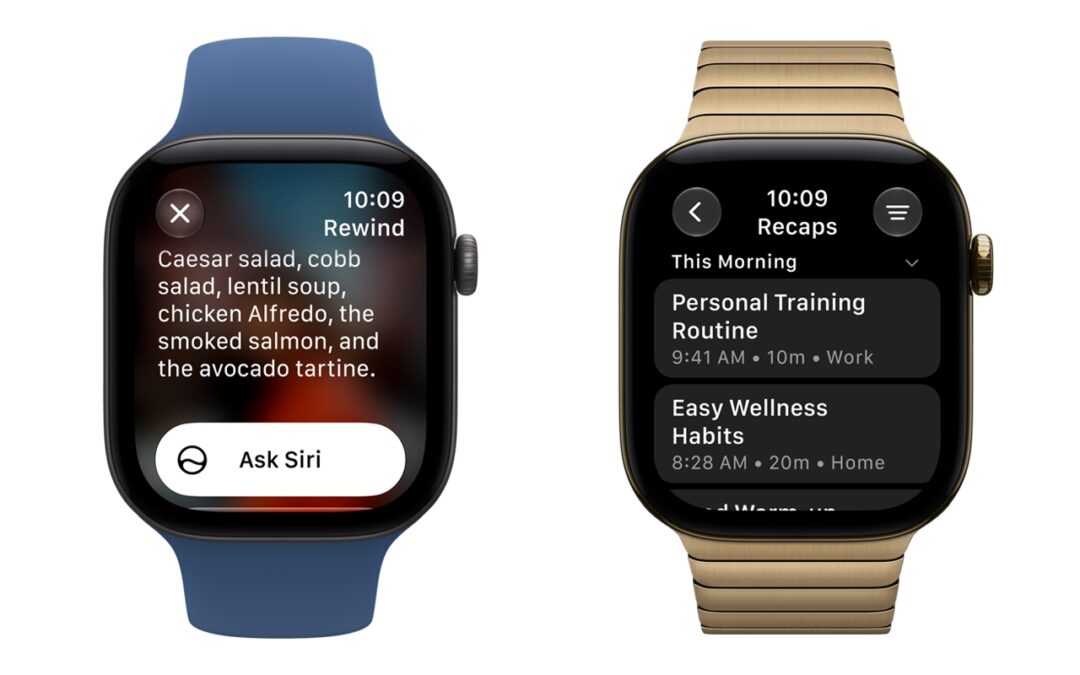
The new Live Rewind and Siri Recap features in the Apple Watch Series 12 and Apple Watch Ultra 4 sound convenient enough. Live Rewind lets you recall anything said in a conversation in the past 15 seconds, while Siri Recap takes notes throughout the day to create an Apple Intelligence summary.
That’s fine unless a meeting covers sensitive information like a personnel dispute, trade secrets, legal advice, or patient information. Before a watch turns workplace conversations into saved notes, employees need to know when that’s appropriate and where the notes may go.
Apple says it will release both features in beta later in 2026, giving businesses time to set rules and tell employees when they can use them.
Understand What the Features Will Do
Apple describes two different ways to help people remember conversations:
- Live Rewind: Double-pressing the Digital Crown will display text from the previous 15 seconds of conversation. You’ll be able to ask Siri about it or save the snippet to the Siri app.
- Siri Recap: When enabled, this feature will generate a title and key points from conversations for later review. It’s intended to provide a summary, without identifying which person said what.
Both features require opting in, and Apple says users will be able to control when and where Siri Recap runs or turn it off from Control Center. Live Rewind will play a chime even when the watch is silenced, accompanied by an on-screen animation and microphone indicator.
Apple says these features won’t create stored audio recordings: protected hardware processes the audio and then deletes it. Saved text will be end-to-end encrypted when synced through iCloud in the Siri app.
These are sensible protections, but they don’t cover every concern a business might have.
Decide Which Conversations Are Appropriate
Start with situations your employees actually encounter. A discussion about arranging the break room carries different expectations from a performance review or a client explaining an unreleased product.
We recommend a short written policy that addresses the following:
- Permitted uses: Identify the kinds of conversations for which employees may use these features. Consider starting with explicitly approved, non-sensitive meetings.
- Confidential discussions: Establish where the features must remain off, such as personnel meetings, legal consultations, and discussions involving client secrets.
- Notice and permission: Tell employees how to explain the intended use and obtain permission before a conversation begins. Give participants an easy way to decline.
- Personal devices: Apply the policy to employees’ own watches and phones as well as company equipment. Explain whom to contact about accessibility needs or exceptions.
A chime is no substitute for asking permission, and a colleague’s Apple Watch isn’t proof that note-taking is active.
Have legal counsel review how applicable privacy and consent rules affect your policy. Employees also shouldn’t assume that a missing audio file makes every use acceptable.
Plan for the Notes That Remain
According to Apple’s support documentation, unsaved Siri Recap summaries will automatically disappear after 7 days. Users will also be able to save or export summaries and Live Rewind snippets to other apps. Deleting an item in Siri will remove it from synced devices. Don’t assume that will retrieve copies already exported or shared.
Decide which accounts and apps may hold work-related notes, who may receive them, and how long they should be retained. Include a process for reporting accidental capture of confidential information, making it clear whom to notify when violations occur.
Apple warns that generated summaries and snippets may omit or misunderstand important details, and that sensitive-information filtering may not catch everything. Require employees to verify commitments, deadlines, and prices before acting on a summary or adding it to an official record.
Healthcare Businesses Need a Closer Review
A patient conversation requires more scrutiny than an ordinary staff meeting. A medical practice considering these features should involve its privacy or compliance lead and IT adviser before allowing employees to use them around patient information.
HHS guidance explains that a cloud provider maintaining electronic protected health information on behalf of a HIPAA covered entity is a business associate—even if it cannot decrypt the information—and must comply with the HIPAA requirements that apply to business associates. Appropriate business associate agreements and other HIPAA safeguards are still required.
Apple’s current iCloud terms also pose a contractual problem. Under Requirements for Use of the Service, they prohibit covered entities, business associates, and their representatives from using the service to create, receive, maintain, or transmit protected health information.
Before approving any proposed use, ask:
- Where will patient information travel? Apple says Siri Recap will use Private Cloud Compute to produce summaries. Review processing, syncing, and exports separately rather than assuming everything stays on the watch.
- Do the applicable agreements permit this use? Identify which services are involved and whether the necessary contractual protections exist for those specific services.
- Can the organization control the resulting notes? Consider access, retention, correction, employee departures, and accidental sharing from personal accounts.
- Who will verify clinical details? Don’t treat an automatically generated memory aid as an approved clinical documentation system.
Until those questions are resolved, we recommend keeping these features off for work conversations involving patient information. Address patients’ own use separately through an appropriate notice and discussion process.
Prepare Now, Test after Release
Apple currently lists Apple Watch Series 12 or Apple Watch Ultra 4, a supported paired iPhone, Apple Intelligence, and Siri AI as requirements for these features, with additional language and regional restrictions.
For now, appoint someone to update your device and confidentiality policies. Ask your IT provider to confirm which management controls will be available when these features launch, especially for personally owned devices.
If your business approves a trial, begin with a small group and non-sensitive conversations. Check how activation, saved notes, exports, and deletion behave before expanding access. Employees should have a clear answer to “May I use this here?” before their watches can offer to help.
(Featured image by Apple)
Social Media: Apple’s upcoming Live Rewind and Siri Recap features will help people remember conversations, but workplaces should prepare rules for sensitive information before the features arrive.




Recent Comments