
by Steve Sorbo | Oct 19, 2026 | TCN Content
Apple is reinvesting in the home in a big way. At its Welcome Home product launch on October 13, 2026, the company introduced the long-rumored HomeView—a touchscreen smart speaker for the whole family—alongside an updated HomePod mini and a next-generation Apple TV. Apple is also partnering with LG and Schneider Electric on a line of home automation products.
Here are the ship dates for the new products:
- HomePod mini 2: Friday, October 30, 2026
- HomeView and Apple TV 4K: Friday, November 13, 2026
- Home Collection: Begins shipping in December
Introducing HomeView
The headline product is the Apple HomeView, a home hub that plays music, controls home automation devices, and makes FaceTime calls. It’s a curious mix of an iPad mini and a HomePod, with a 7-inch display on a domed speaker base. It’s Apple’s answer to Amazon’s Echo Show and Google’s Nest Hub.

The most interesting thing about the HomeView is that it recognizes up to six people by face, and each gets a personalized Home Screen. Apple customers have wanted multiple user accounts on the iPad for years, and this will only increase that demand.

The HomeView has no App Store. It comes with 15 built-in apps, including:
- Calendar
- FaceTime
- Find My
- Messages
- Reminders
Third-party apps are limited to CarPlay-enabled audio and video apps, such as Spotify, which run from a paired iPhone. Like the Apple Watch, the HomeView also supports multiple “faces,” each with different sets of widgets, shortcuts, and stylings.
The HomeView leans heavily on Apple’s new Siri AI, which isn’t available in the European Union, so Apple isn’t selling it there. At launch, the HomeView will be available in the United States, United Kingdom, Canada, Australia, New Zealand, India, Singapore, and South Africa.
The HomeView costs $299 in either of two versions: tabletop and wall-mounted. The wall-mounted version lacks the built-in subwoofer and requires a separate Schneider Home mount: $59.95 for USB-C or $79.95 for AC wired, both available now, or $129.95 for Power over Ethernet (PoE), which arrives in early 2027.

The HomeView makes the most sense for families heavily invested in Apple Home who want a shared control panel for their home automation devices.
It could also work in a small office as a conference-room FaceTime station or a front-desk control panel, but Apple isn’t positioning it for business use yet.
Buy, Skip, or Wait? Wait. Almost everyone can afford to hold off on this one—it’s a product sure to mature and gain more functionality over time.
Fourth-generation Apple TV 4K
At $299, the new Apple TV 4K costs more than nearly any other streaming box on the market, and, puzzlingly, it still doesn’t support 120 Hz video.
Apple TV prices have been climbing steadily, and Apple has blamed soaring demand for memory and storage chips from AI data centers. In June, Apple raised Apple TV prices from $129 to $199 for the 64 GB model and from $149 to $249 for the 128 GB model. Apple has now consolidated to a single 128 GB model, simplifying the lineup.
Beyond the expected speed boost from the A19 chip, the most interesting addition is a set of three far-field microphones for hands-free Siri. It can also drive up to four HomePods for surround sound, either the second-generation HomePod or the new HomePod mini 2. You can mix and match speakers as long as each pair matches—for example, two full-size HomePods in front and two HomePod mini 2 units in the rear. Original HomePod minis and first-generation HomePods aren’t supported.
Since nearly every smart TV and streaming stick now supports the Apple TV app and AirPlay, the Apple TV 4K is increasingly a device for people who want the best tvOS experience, tight Apple Home integration, or an Apple Home hub. If you already own a second-generation or later Apple TV 4K, there’s little reason to upgrade—Apple says Siri AI is coming to your existing box, starting in beta with tvOS 27.2.
Here’s another welcome upgrade for existing Apple TV owners: a new, improved Siri Remote with built-in Find My. It’s included with the new Apple TV but is available as a separate $59 purchase for owners of existing Apple TV HD and 4K models. Precision Finding requires an iPhone Duo, iPhone Air, or iPhone 17 or later (not the 17e). With any other iPhone, you’ll have to make the remote play a sound to find it.
Buy, Skip, or Wait? Skip. The price is hard to justify unless you’re a die-hard Apple TV fan, and the best upgrades are coming to older models.
HomePod mini 2
The HomePod mini 2 offers modest upgrades over the original at a higher price of $149. It will support Siri AI in a future update, while the original will not. It ships in blue, green, midnight, pink, and white.

Beyond serving as surround speakers for the new Apple TV 4K, the HomePod mini 2 can be a Mac’s default speaker, alone or in a stereo pair (the Mac needs Wi-Fi 6E or later).

Another neat feature: the top surface pulses in rhythm with the music, a feature Apple calls Sound Glow.
Buy, Skip, or Wait? Buy, if you’re in the market for a smart speaker, but don’t rush to replace your existing HomePod minis unless Siri AI, Apple TV surround sound, or Mac speaker support matters to you.
Apple Home Collection
Apple has long left smart home hardware to other companies, first through its Works with Apple Home certification, which offered a small assortment of accessories at relatively high prices. Then it embraced the cross-platform Matter standard, which greatly expanded compatible accessories at lower prices, but at the cost of ambiguous accessory reliability and quality.

Apple is now swinging back in the other direction with the new Apple Home Collection. It’s a lineup of cameras, a lock, and thermostats built with LG Electronics and Schneider Electric and sold through Apple’s online and retail stores:
- LG Video Doorbell (Wired): Dual cameras (2.5K facing out, full HD facing down to catch packages), a built-in spotlight, and a chime that plays through a HomeView, HomePod, or HomePod mini. $249.95.
- LG Indoor Cam: Tilts automatically and turns away from the room when someone in the household comes home, so it isn’t recording you while you’re there. $199.95.
- LG Outdoor Cam and Floodlight Cam: Low-light color night vision. The Floodlight Cam adds dual floodlights that turn on when motion is detected. $299.95 and $399.95.
- LG Smart Deadbolt Lock: Unlocks automatically as you approach with your iPhone or Apple Watch, which use Apple’s Ultra Wideband chip to tell when you’re near. It also offers a PIN pad, a hidden backup key, and tap-to-unlock, and it keeps working locally if your Internet connection goes down. $349.95 (US and Canada only).
- LG and Schneider Home Smart Thermostats: Both offer Adaptive Temperature, and in the contiguous US, with a compatible utility plan, they can shift heating and cooling to times when electricity is cheaper or cleaner. $199.95 each, with $39.95 room sensors and optional $24.95 C-wire adapters (US and Canada only).

As usual, privacy is Apple’s key selling point. Apple says Home app data is end-to-end encrypted so that neither Apple nor its partners can read it, and camera footage is analyzed on your home hub or in Apple’s Private Cloud Compute rather than on a manufacturer’s servers. You don’t have to wonder whether someone is watching your security camera footage without your knowledge.
There are strings attached. The cameras are sold only in the US, Canada, and the UK, and they need an iCloud+ plan to store 10 days of event history: 50 GB covers one camera, 200 GB covers up to five, and 2 TB covers unlimited cameras. Those plans cover recording only. Apple’s new AI video summaries need at least the $9.99-per-month 2 TB plan for a single camera, and summaries on five cameras require the $59.99-per-month 12 TB plan—there’s no option beyond that. You’ll also need a home hub (HomeView, HomePod, HomePod mini, or Apple TV 4K) for many features. Apple says the collection starts shipping in December, but some accessories won’t arrive until early 2027, and it hasn’t said which. US customers can pay extra for professional installation by ADT through Apple Retail.
Buy, Skip, or Wait? Wait. If your home already runs on Apple Home and you’ve put off cameras or a smart lock because of privacy worries, the Home Collection is the most trustworthy option Apple users have had. The prices are on the high side, though, and smart home devices are hard to swap out once mounted, so it’s worth waiting for early camera reviews before you commit.
(Featured image by Apple)
Social Media: Apple’s Welcome Home event brought the HomeView smart display, a $299 Apple TV 4K, the HomePod mini 2, and Apple-branded cameras, locks, and thermostats. Here’s what’s worth buying now—and what to skip.

by Steve Sorbo | Sep 10, 2026 | TCN Content, Uncategorized
Apple’s annual September event delivered more than the usual annual iPhone and Apple Watch updates. Alongside the iPhone 18 Pro and iPhone 18 Pro Max, new Apple CEO John Ternus led the unveiling of the iPhone Duo—Apple’s first foldable iPhone—the Apple Watch Series 12 and Ultra 4 with new health-sensing and listening capabilities, and the AirPods 5 with Active Noise Cancellation available in both models.
After the event, Apple confirmed that iOS 27, watchOS 27, macOS 27 Golden Gate, iPadOS 27, tvOS 27, and visionOS 27 will ship on September 14. As always, we recommend waiting a week or two before upgrading essential devices and holding off on Golden Gate for a few months until you’re confident your necessary Mac apps are compatible. Always make a backup before upgrading.
Let’s examine the new products.
iPhone 18 Pro and iPhone 18 Pro Max
The iPhone 18 Pro and iPhone 18 Pro Max boast improvements to the camera system, performance, and battery life. Apple did not announce a plain iPhone 18—rumors suggest it will arrive in early 2027.
The headline feature is the new 48-megapixel Fusion Main camera with a variable aperture. For the first time on the iPhone, the camera offers four aperture settings: ƒ/1.48, ƒ/1.8, ƒ/2.8, and ƒ/4.0. The Camera app automatically adjusts the aperture based on lighting conditions, but photographers can also take manual control through new Pro controls. The wider ƒ/1.48 maximum aperture should improve low-light performance and provide shallower depth of field for better bokeh. The Ultra Wide and Telephoto cameras remain unchanged from the iPhone 17 Pro.
Performance should be noticeably better. The A20 Pro chip delivers up to 20% faster CPU performance and 40% faster GPU performance compared to last year’s A19 Pro. The chip also features a Dual 16-core Neural Engine with double the AI processing power.
Apple redesigned the Dynamic Island—where the Face ID sensor lives—to be smaller while displaying more information, now showing up to three Live Activities simultaneously.
Battery life is also better. In Apple’s new “typical use” battery metric, the iPhone 18 Pro offers up to 24 hours, while the Pro Max delivers up to 30 hours. Fast charging has improved as well—the iPhone 18 Pro can add 50% in just 15 minutes with a 60W or higher adapter.

The iPhone 18 Pro starts at $1,199 and the Pro Max at $1,299—$100 increases over last year’s models due to the ongoing memory shortage. Storage upgrade prices have also jumped significantly. Available colors include black, silver, glacier, and burgundy. Pre-orders open at 5 AM Pacific on September 12, with availability beginning on September 18.
If those prices are too steep for your budget, the iPhone 17e ($699), iPhone 16 ($799), iPhone 17 ($899), and iPhone Air ($1,099) remain available, all $100 more than before the event.
Should you upgrade? The iPhone 18 Pro models look great, but unless you want the best possible camera, highest possible performance, and longest battery life, we recommend holding off. An iPhone 15 Pro or newer model that supports Apple Intelligence, which Apple is emphasizing in iOS 27, will likely still meet your needs.
iPhone Duo
The most surprising announcement was the iPhone Duo, Apple’s first foldable iPhone. While foldable Android phones have been interesting but often flawed, the iPhone Duo showcases Apple’s attention to industrial design and software integration.

Closed, the iPhone Duo is about the size of a passport book, with a 5.4-inch outer display that provides 90% of the screen area of the iPhone 18 Pro. When opened, the 7.6-inch inner display is 50% larger than the iPhone 18 Pro Max, offering more screen space for media, gaming, and productivity apps. A nano-texture finish on the inner display reduces glare and minimizes the visibility of the crease.
Apple says that the iPhone Duo’s hinge and integrated magnet array deliver a smooth, secure feel. Despite the hinge, it’s still rated IP68 for water resistance (up to 6 meters for 30 minutes), the same as the iPhone 18 Pro. Ceramic Shield and Ceramic Shield 2 protect from scratches on the back and front, respectively.
Unlike other current iPhones, the iPhone Duo uses Touch ID in the side button rather than Face ID. It’s powered by the same A20 Pro chip as the iPhone 18 Pro models, and Apple claims 24 hours of battery life in typical use.
Apple has reimagined iOS 27 for the iPhone Duo. Lock Screen controls, the Dock, the Dynamic Island, and app navigation appear on the side to maximize vertical content space. When open, the display shows two Home Screen pages with Today View—a scrolling list of widgets—on the left. Content reacts as the iPhone Duo folds, reorients when turned sideways, and switches to the appropriate display when flipped over. iOS on the iPhone Duo even borrows from iPadOS—Split View lets two apps run side by side. StandBy can kick in whenever the iPhone Duo is set down, even if it’s not charging.
The camera system includes a 48-megapixel Fusion Main camera and a 48-megapixel Fusion Ultra Wide, but no variable aperture or Telephoto camera. The folding design enables different camera experiences: Smart Take uses on-device AI to capture photos automatically while subjects are posing, Duo Preview shows a live preview on the outer display so subjects can guide the shot, and Kid Cue plays Peanuts animations to grab children’s attention. Duo FaceTime lets people who are with the user join a video call on the outer display.

The iPhone Duo starts at $1,999 in star white and night sky colors, with pre-orders opening October 16 and availability starting October 23. Apple Pencil support is coming later this year.
The iPhone Duo is clearly aimed at early adopters and those who want a larger display in a pocketable form factor. At $1,999, it costs more than an iPhone 18 Pro and an iPad mini combined, but for those waiting for Apple to enter the foldable market, the iPhone Duo is worth checking out.
Apple Watch Series 12 and Ultra 4
The Apple Watch Series 12 and Apple Watch Ultra 4 focus on health sensing accuracy and introduce Audio Intelligence features powered by the new S11 chip.
The new Health Sensing System delivers what Apple calls “the most accurate heart rate sensing in a wearable.” Larger, more power-efficient green LEDs now measure heart rate every 5 seconds throughout the day—60 times more frequently than before. Heart rate variability is measured up to 24 times more often.
These improvements power a new Readiness feature that analyzes recent activity, training load, vitals, and sleep score to provide a 0-10 score with recommendations: Recover, Pace Yourself, Ready, or Go For It. The score updates throughout the day as new data arrives.
Audio Intelligence represents a new category of Apple Watch features. Sound Recognition alerts Deaf users or those who are hard of hearing to sounds like doorbells, sirens, or crying babies. Shazam now automatically identifies nearby music and displays it in the Smart Stack. Live Rewind shows the previous 15 seconds of conversation as text when you double-press the Digital Crown. Siri Recap creates high-level summaries of conversations for later review. Live Rewind and Siri Recap will arrive in beta later this year and require an iPhone 16 or later, excluding the iPhone 16e.
Although the prospect of an always-listening watch has already raised privacy concerns, Apple emphasizes that Audio Intelligence features don’t create or store audio recordings: raw audio is processed in a hardware-isolated Secure Exclave and immediately deleted, while Live Rewind snippets and Siri Recap summaries synced via iCloud are end-to-end encrypted. We’ll see whether the features prompt the same kind of privacy backlash as Meta’s controversial AI glasses.
The Series 12 now offers up to 10 hours of workout battery life—25% more than the Series 11—while maintaining 24 hours of everyday battery life. Charging is faster: 15 minutes provides up to 12 hours of battery life.
Aluminum models gain Ceramic Shield 2, which Apple says is 60% tougher than the previous Ion-X glass. A new ceramic case option is available in pearl white and night blue. Other finishes include dark bronze, black, light gold, and space gray aluminum, plus radiant gold and natural titanium.

The Apple Watch Ultra 4 gains the same Health Sensing System and Audio Intelligence features, plus improved battery life: up to 50 hours of everyday use, up to 25 hours in Extended Workout mode with full GPS and heart rate, and up to 45 hours in Max Extended Workout mode. It also shares the new fast charging.

Pricing remains unchanged: the Series 12 starts at $399, and the Ultra 4 at $799. Pre-orders are available now, with availability on September 18. The Apple Watch SE 3 remains available, starting at $249.
For most people with an Apple Watch Series 10 or 11, the upgrade may be hard to justify unless Audio Intelligence features are particularly compelling. Those with older models may be considering an upgrade for refreshed battery life, and remember that watchOS 27 requires a Series 9 or later, SE 3, or Ultra 2 or later.
AirPods 5
The AirPods 5 bring Active Noise Cancellation to Apple’s entire open-ear AirPods lineup for the first time. Both the base model and the model with wireless charging case now include ANC, along with Transparency mode, Adaptive Audio, Conversation Awareness, Voice Isolation, Personalized Spatial Audio, and Live Translation.
The AirPods 4 were rated IP54 for dust and water resistance, while the AirPods 5 improve that to IP57, meaning they should survive temporary immersion for up to 30 minutes.
The wireless charging case model retains a few exclusive features: volume swipe on the stems, longer battery life (5 hours with ANC versus 4 hours on the base model), support for Apple Watch and Qi chargers, and a speaker in the case for Find My.

The AirPods 5 with Wireless Charging Case costs $149, $30 less than the $179 AirPods 4 with ANC it replaces, while the base model remains at $129. This makes Active Noise Cancellation more accessible than ever, though those who need maximum noise cancellation should still consider the AirPods Pro 3. It’s probably not worth upgrading from working AirPods unless you need better ANC, but the AirPods 5 will be waiting the next time you need a pair.
(Featured image by Apple)
Social Media: Apple has introduced the iPhone 18 Pro with a variable-aperture camera, the foldable iPhone Duo, Apple Watch Series 12 and Ultra 4 with advanced health sensing, and AirPods 5 with noise cancellation. Here’s what’s new and whether you should upgrade.

by Steve Sorbo | Aug 27, 2026 | TCN Content, Uncategorized
In a move designed to clear the decks in advance of the company’s September 9th iPhone and Apple Watch unveiling, Apple has refreshed its compact desktop Mac lineup with new chips, faster connectivity, and—unsurprisingly given the ongoing memory shortage—higher prices. The Mac mini receives the new M6 chip and M5 Pro, while the Mac Studio gains the M5 Max and the new M5 Ultra. Both are available for pre-order now and ship September 22.
Mac mini Gets M6 and M5 Pro
Skipping the M5 at the base level, the Mac mini debuts Apple’s new M6 chip, which is the first to use a 2-nanometer manufacturing process that promises increased performance and power efficiency. The M6 features a 12-core CPU (two more than before) and a 12-core GPU with Neural Accelerators in each core—a first for the Mac mini. Apple claims up to 4x faster AI performance compared to the M4 model, along with 2x faster graphics and storage. 16 GB of unified memory is standard, with 24 GB and 32 GB options.

For users who need more power, the Mac mini with M5 Pro offers a 15-core or 18-core CPU and a 16-core or 20-core GPU, with 24 GB of memory standard and support for up to 64 GB. The M5 Pro model also includes Thunderbolt 5 ports instead of the M6’s Thunderbolt 4 ports.
Both models gain Wi-Fi 7, Bluetooth 6, Thread, and upgraded 2.5Gb Ethernet (with 10Gb available as an option). New genlock support through USB-C enables precise synchronization between a display and camera—including iPhone 17 Pro—for video professionals who need frame-accurate capture. The front panel retains two USB-C ports and a headphone jack.
Pricing continues to climb. The M6 Mac mini starts at $899—$100 more than the post-June M4 pricing and $300 more than the original M4 launch price. The M5 Pro model starts at $1,699, up $100 from the June adjustment.
Mac Studio Adds M5 Max and M5 Ultra
The Mac Studio receives the M5 Max and the new M5 Ultra, Apple’s most powerful chip ever. The M5 Ultra uses a quad-die architecture—combining four smaller dies rather than two larger ones—which improves manufacturing yields while delivering extraordinary performance.

The M5 Max model offers an 18-core CPU, a 32-core or 40-core GPU, and 36 GB to 128 GB of unified memory—plenty for most professional workflows.
When that’s not enough, the M5 Ultra features a 30-core or 36-core CPU, a 64-core or 80-core GPU with Neural Accelerators, and 96 GB to 512 GB of unified memory with 1.2 TB/s of bandwidth. Apple claims up to 4.3x faster AI performance compared to the M3 Ultra and 1.8x faster graphics. For teams running large AI models locally, multiple Mac Studio systems can be clustered via Thunderbolt 5 and RDMA (remote direct memory access) to create a shared memory pool.
Both Mac Studio models gain Wi-Fi 7, Bluetooth 6, and Thread via Apple’s N1 wireless chip. Storage performance doubles thanks to a new SSD architecture. As with the Mac mini, genlock support through USB-C enables frame-accurate synchronization between displays and cameras.
The M5 Max Mac Studio starts at $2,499—unchanged from the June price hike. The M5 Ultra model starts at $5,499, up $200 from June (and $1,500 more than the pre-June price). The 512 GB memory configuration won’t ship until October.
Should You Upgrade?
For users with M1 or M2 Mac mini models, the performance gains may be substantial enough to justify an upgrade. Those with M4 Mac mini models can probably wait unless they specifically need the M6’s improved AI capabilities or the M5 Pro’s additional memory and Thunderbolt 5. And if you’re still using an Intel-based Mac mini for anything where performance matters, upgrade immediately—the difference is like night and day.
Mac Studio users face a different equation. The M5 Max and M5 Ultra deliver meaningful improvements for performance-driven professionals whose work involves large-scale video projects, complex 3D rendering, or AI inference. For such users, the speed improvements may justify upgrading even from M4 Max or M3 Ultra machines.
The memory crisis shows no signs of abating, so don’t assume prices will drop. If you need a new desktop Mac and one of these new models fits in your budget, they’re all excellent choices.
(Featured image by Apple)
Social Media: New M-series chips! Apple’s refreshed Mac mini debuts the M6 chip, while the Mac Studio gets the speedy M5 Ultra with up to 512 GB of unified memory. Performance soars—but so do prices amid the memory shortage.
by Steve Sorbo | Jul 3, 2026 | Uncategorized
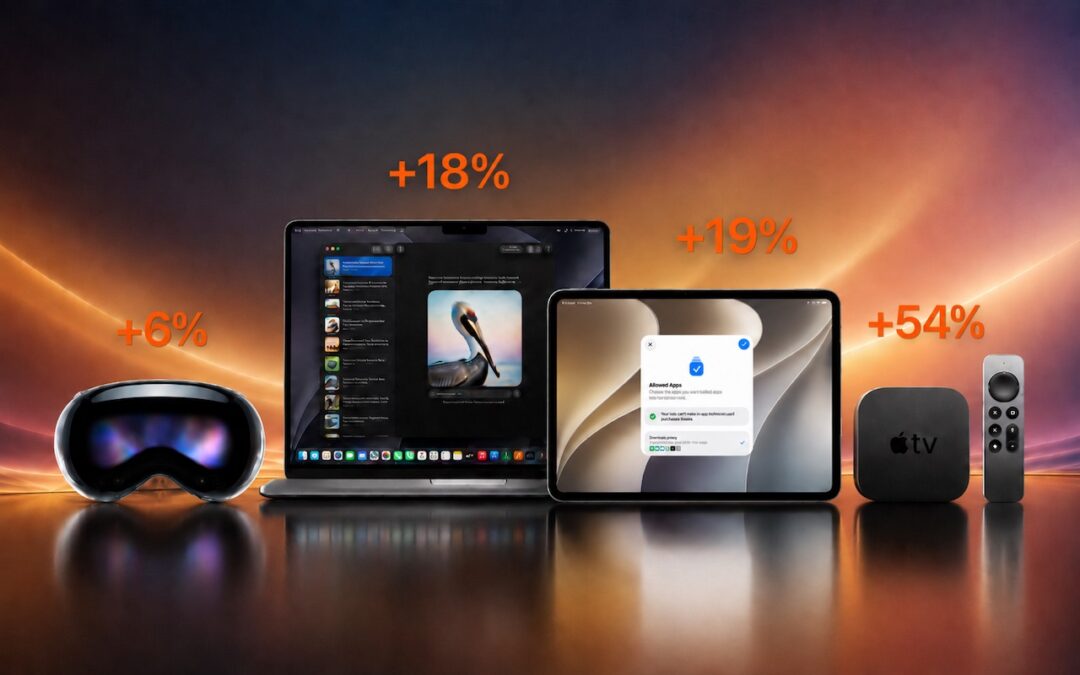
There’s no way to put a positive spin on this: Apple has raised prices across most of its product lineup, with increases averaging 20% on Macs, iPads, HomePods, the Apple TV, and even the Vision Pro. The iPhone and Apple Watch remain unaffected… for now.
The price hikes took effect on June 25. In a statement to the press, Apple blamed the AI industry’s insatiable appetite for memory chips, which has caused prices for memory and storage to increase up to sixfold:
The consumer electronics industry is facing an unprecedented challenge. The rapid expansion of AI data centers has created an extraordinary surge in demand for memory and storage. We have never seen a component price increase this much, this quickly. We have shielded our customers from these increases so far, but we have now reached a point where we need to begin raising prices on a number of products.
Apple’s price increases vary widely. The base model of the Apple TV 4K took the biggest percentage hit, jumping from $129 to $199—a 54% increase that’s particularly puzzling given the device has only 64 GB of storage and 4 GB of memory. It may be setting a new price floor for the next-generation Apple TV. At the other end of the percentage increase spectrum, the Vision Pro rose just 6%, from $3,499 to $3,699.
Mac and iPad Price Changes
The Mac lineup saw significant increases at both the low and high ends:
- MacBook Neo: $599 → $699 (+17%)
- MacBook Air (13-inch): $1,099 → $1,299 (+18%)
- MacBook Pro (14-inch base): $1,699 → $1,999 (+18%)
- Mac mini (M4): $599 → $799 (+33%)
- Mac Studio (M3 Ultra): $3,999 → $5,299 (+33%)
The $1,300 increase for the M3 Ultra model of the Mac Studio is the largest absolute dollar jump in the lineup—a reflection of just how much high-memory configurations are affected by the shortage.
iPads saw increases of 15–30%, with the base iPad hit hardest:
- iPad: $349 → $449 (+29%)
- iPad mini: $499 → $599 (+20%)
- iPad Air (11-inch): $599 → $749 (+25%)
- iPad Air (13-inch): $799 → $949 (+19%)
- iPad Pro (11-inch): $999 → $1,199 (+20%)
- iPad Pro (13-inch): $1,299 → $1,499 (+15%)
Base prices tell only part of the story. Memory and storage upgrade prices also jumped dramatically, with the 64 GB and 128 GB memory upgrades for M5 Max models of the MacBook Pro doubling in price.
Why iPhones and Apple Watches Were Spared
Apple left the prices for the iPhone, Apple Watch, AirPods, and Studio Display unchanged. The Studio Displays and AirPods likely escaped because they use minimal memory. The iPhone and Apple Watch are a different story—Apple may be willing to accept lower margins on its flagship products, betting that stable prices will drive enough additional sales to offset reduced profit per unit.
There’s also the timing factor. New iPhone and Apple Watch models are expected in September, and rumors suggest Apple will introduce only high-end (and higher margin) iPhone 18 models then, with more affordable models held until early 2027. That makes buying a current-generation iPhone now potentially the better deal—new models will almost certainly debut at higher prices.
Apple Isn’t Alone
The memory crisis has hit the entire consumer electronics industry. Microsoft raised prices on all Surface PCs. Samsung is raising prices on its Galaxy smartphones. Lenovo, HP, and Dell have all raised laptop prices.
The culprit is the industry’s rapid expansion into AI. Data centers are consuming memory and storage at a pace the industry wasn’t equipped to handle. Memory chip suppliers like Micron, Samsung, and SK Hynix have directed production toward AI chipmakers like Nvidia, who are willing to pay top dollar, leaving consumer electronics to compete for whatever remains. Industry observers expect the shortage to persist through at least 2027 due to the time required to build manufacturing capacity.
What Should You Do?
If you need a Mac or iPad, some retailers may not have updated prices yet, but that won’t last. Similarly, you could look for a refurbished Mac from Apple or a certified pre-owned Mac from retailers like OWC, but those prices have largely increased as well.
For the iPhone and Apple Watch, the calculus is unusual: normally, we’d encourage waiting for September’s new models, but this year, buying now at current prices may save you some money.
Ultimately, the only options may be to bite the bullet and pay current prices, buy a less-expensive model or configuration, or hold on to your existing hardware in the hopes that prices come back down.
(Featured image generated by Adam Engst with ChatGPT)
Social Media: Apple just raised Mac and iPad prices by 15–33%, blaming the AI industry’s hunger for memory and storage chips. The iPhone and Apple Watch were spared, but the next new models may be more expensive. Here’s what you need to know.

by Steve Sorbo | Mar 6, 2026 | Uncategorized
Apple has updated its Studio Display with an improved 12-megapixel Center Stage camera with Desk View support, two Thunderbolt 5 ports, and improved bass from its six-speaker system—all for the same $1,599 starting price. More significantly, Apple introduced the Studio Display XDR at $3,299, bringing professional-grade HDR technology to a broader audience at a much lower price than the $5,000 Pro Display XDR it replaces. The Studio Display XDR features a 27-inch 5K panel with mini-LED backlighting, 2304 local dimming zones, up to 2000 nits of peak HDR brightness, a 1,000,000:1 contrast ratio, and a 120 Hz refresh rate with Adaptive Sync. Both displays require macOS 26.3.1 Tahoe and work with all Apple silicon Macs.

(Featured image by Apple)
Social Media: Apple’s new $3,299 Studio Display XDR brings mini-LED, HDR, and 120 Hz to a 27-inch 5K display—pro display tech at a far more accessible price. The standard Studio Display also gets a refresh with a better camera and Thunderbolt 5.

Recent Comments